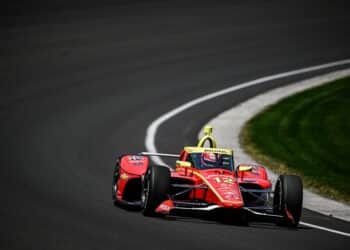
A look at the best Indy 500 traditions that help make The Greatest Spectacle in Racing one of the most iconic events on the sporting calendar.
Add us as a preferred source on Google searches!

The Indianapolis 500 is about as tradition-rich as any sporting event in the world. First contested on Memorial Day Weekend in 1911, the race has accumulated more than a century’s worth of customs, ceremonies and iconic moments that set it apart from every other event on the motorsports calendar. The pageantry and magnificence of it all is enough to captivate diehard IndyCar fans and brand new viewers alike.
With the 110th running of the Greatest Spectacle in Racing upon us, here is a look at five of the most iconic Indy 500 traditions.
Top 5 Indy 500 Traditions
Singing “Back Home Again in Indiana”
Few pre-race moments in all of sports carry the emotional weight of “Back Home Again in Indiana” echoing through Indianapolis Motor Speedway on race morning. The song, first published in 1917 just six years after the inaugural Indy 500, has been a fixture of the race’s pre-race ceremonies since 1946 when James Melton performed it over the public address system alongside the Purdue Marching Band.
The performance was so well-received that race organizers invited Melton back the following year, and the tradition has carried forward ever since. Since 2017, tenor Jim Cornelison has served as the voice of the tradition at IMS, delivering a performance that has become one of the most anticipated moments of race morning.
The song is performed just prior to the command to start the engines — a moment that sends chills through anyone lucky enough to be in the stands. Avid Indy and racing fans know full well that it can do the same to those watching at home.
Milk and Wreath to the Winner
To the victor goes the spoils — and at Indianapolis, those spoils include a glass of cold milk and a laurel wreath. The milk tradition traces back to three-time winner Louis Meyer, who reached for a glass of buttermilk out of habit after winning the 1936 race on a hot day. It turned out that an executive from a dairy industry organization happened to be watching and loved the imagery. Officially, milk has been one of the Indy 500 traditions annually since 1956 — with the occasional notable exception from drivers who simply cannot stomach it.
If sportsbooks really wanted to get creative with their Indy 500 betting props, some odds on which type of milk the winner will drink would be a very fun twist! Odds could be quite realistic at that as drivers declare their milk choice days in advance of the race itself.
As for the laurel wreath, that tradition dates to 1960, when Jim Rathmann was presented with one after that year’s victory. The wreath features 33 Cymbidium orchids — ivory with burgundy tips — and 33 miniature flags, one for each car in the starting field.
Memorial Day Weekend
Sometimes, it’s easy to overlook one of the Indy 500 traditions hiding in plain sight — the date itself. The Indianapolis 500 has been a Memorial Day Weekend institution since the very first race in 1911. While the exact date has shifted over the years, the connection to the holiday weekend has remained unbroken for well over a century.
The military connection runs deeper than the calendar, however. The pre-race flyover has become a staple of race day at IMS, a thunderous reminder of the holiday’s true meaning as jets scream over the packed grandstands. In recent years, the “Pace Lap for America” featuring U.S. Army Apache helicopters flying over the cars on their warm-up laps, has added another layer to that tribute — a moving nod to the men and women who have served the country, timed perfectly to the energy of race morning before the field takes the green flag.
Together these moments make the Indianapolis 500 feel like more than a race. It is an American institution. For millions of fans, Memorial Day Weekend and the Indy 500 are simply inseparable.
Kissing the Bricks
When the first Indy 500 was run in 1911, the entire Indianapolis Motor Speedway racing surface was made up of bricks — all 3.2 million of them. That is how the track earned its iconic nickname, “The Brickyard”. Over the decades, the bricks were gradually paved over with asphalt until only a three-foot strip remained at the start/finish line. That strip is the site of one of the most beloved post-race traditions in motorsports.
After winning the NASCAR Cup Series Brickyard 400 in 1996, Dale Jarrett got down on all fours and kissed the bricks. Gil de Ferran brought it to the list of Indy 500 traditions in 2003 after claiming victory that year. Today any winner at Indianapolis Motor Speedway, regardless of the event, is welcome to drop to their knees and pay homage to the history beneath them.
The Borg-Warner Trophy
Every major sport has its iconic championship trophy. The Lombardi. The Stanley Cup. The Larry O’Brien. The Indianapolis 500 has the Borg-Warner Trophy — and it holds its own among the most distinguished pieces of hardware in sports.
First awarded to the Indy 500 winner in 1936, the trophy is made of sterling silver and weighs 110 pounds. What makes it truly special is what adorns it — a sculpted face representing every single Indianapolis 500 winner in the history of the race. Similar in spirit to the Stanley Cup’s tradition of engraving championship rosters, the Borg-Warner immortalizes each winner in silver.
The trophy has been expanded multiple times over the decades to accommodate new champions and currently has space for winners through the mid 2030s. One non-winning face also appears on the trophy — late IMS owner Anton “Tony” Hulman, sculpted in gold on the base in 1987 in recognition of his immeasurable contributions to the event.